
Waiting list starts growing again
16/12/2025by Rob Findlay
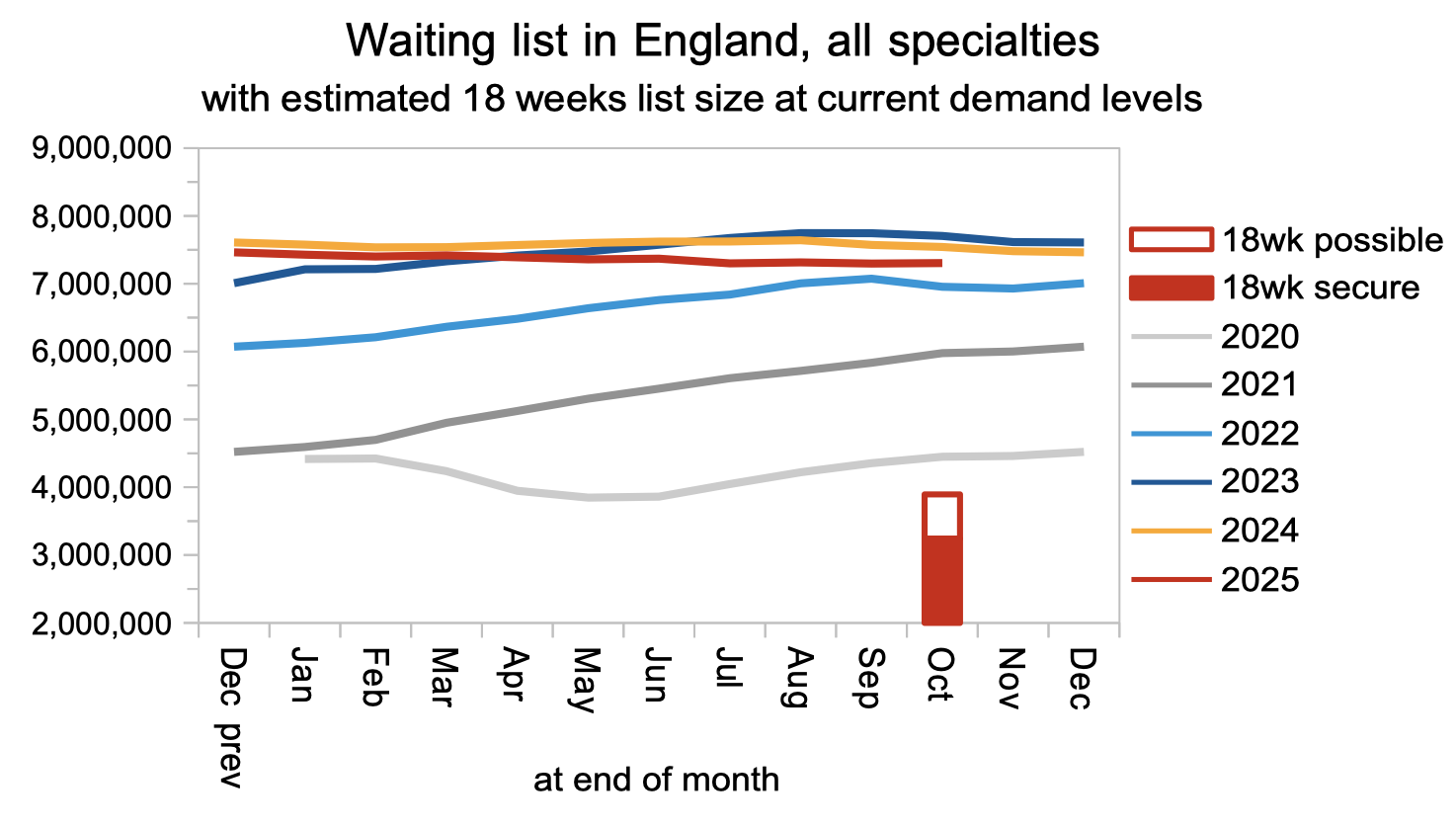
The English referral-to-treatment (RTT) waiting list for elective care grew by 6,000 patient pathways in October.
This is bad news for the government’s pledge to restore the statutory ’18 weeks’ waiting time standard by March 2029. If recovery had been on track, the waiting list would have fallen by around 87,000 pathways instead.
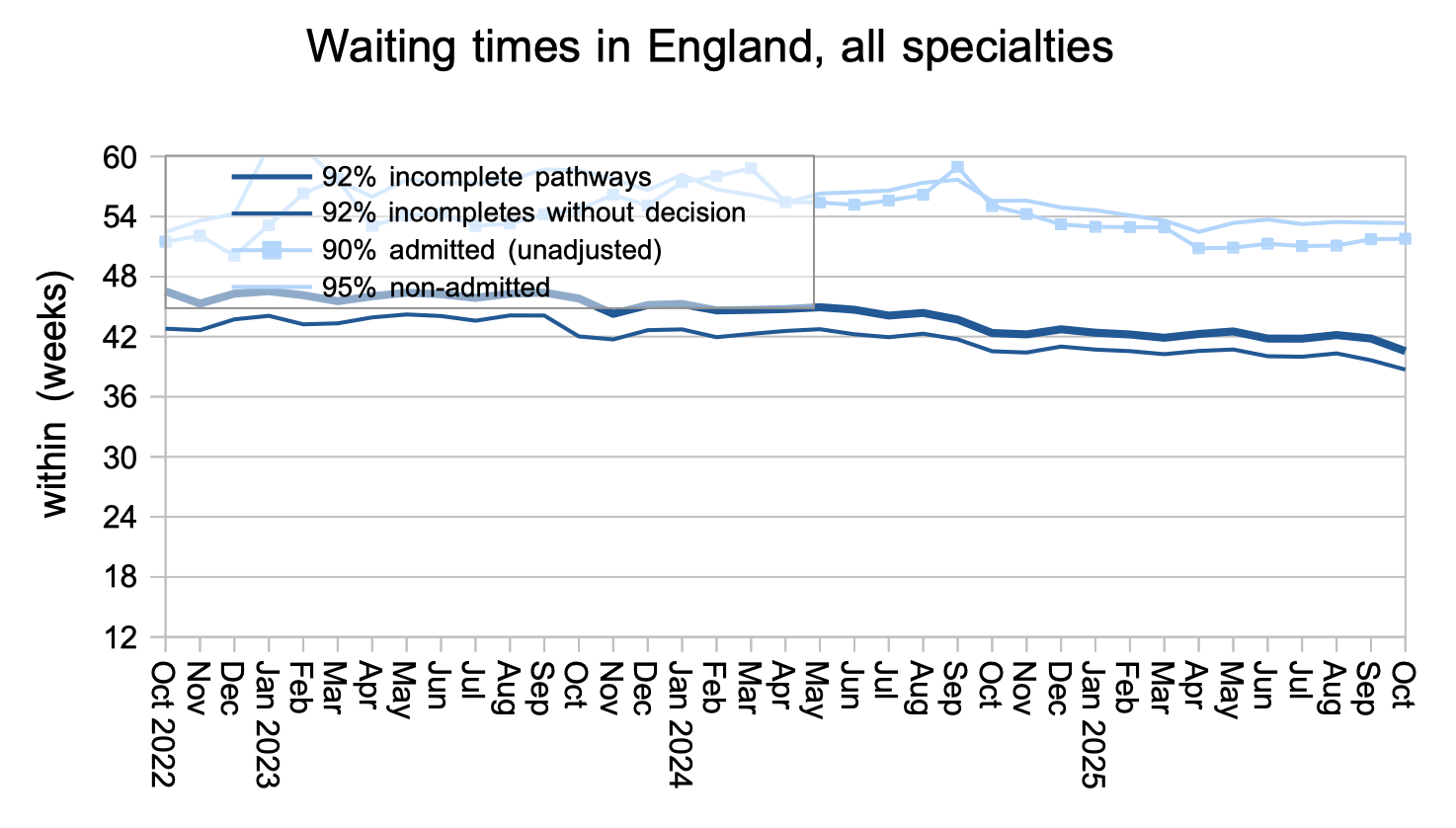
In better news, RTT waiting times shortened by 1.3 weeks to 40.6 weeks, and the wait for diagnosis and ‘decision to admit’ shortened by 0.9 weeks to 38.7 weeks. There are now an estimated 26,587 patients on the RTT waiting list whose eventual diagnosis will unexpectedly be cancer. Because they have not been diagnosed and are not yet on a cancer pathway, they will typically wait as long as everyone else for diagnosis and decision, and 38.7 weeks is far too long.
Every now and again we should remind ourselves of another, even larger group of patients who are at clinical risk because their care is delayed: those who are overdue a follow-up outpatient appointment for a chronic disease. Their numbers soared during the pandemic, probably into the millions, but no data is being published about them. They compete for capacity with outpatients on the RTT waiting list, and trusts will want to take this backlog into account in the current planning round.
In the following discussion, all figures come from NHS England. You can look up your trust and its prospects for achieving the waiting time targets here.
The numbers
The waiting list needs to shrink to about 4 million patient pathways by March 2029 for the ’18 weeks’ recovery to be achievable. (NHS England and DHSC make a similar estimate.) If the NHS does not make enough progress one month, the shortfall does not evaporate but is added to the challenge for the remaining months. If disappointing progress continues, then at some point the trajectory to ’18 weeks’ recovery will become too steep to be credible.
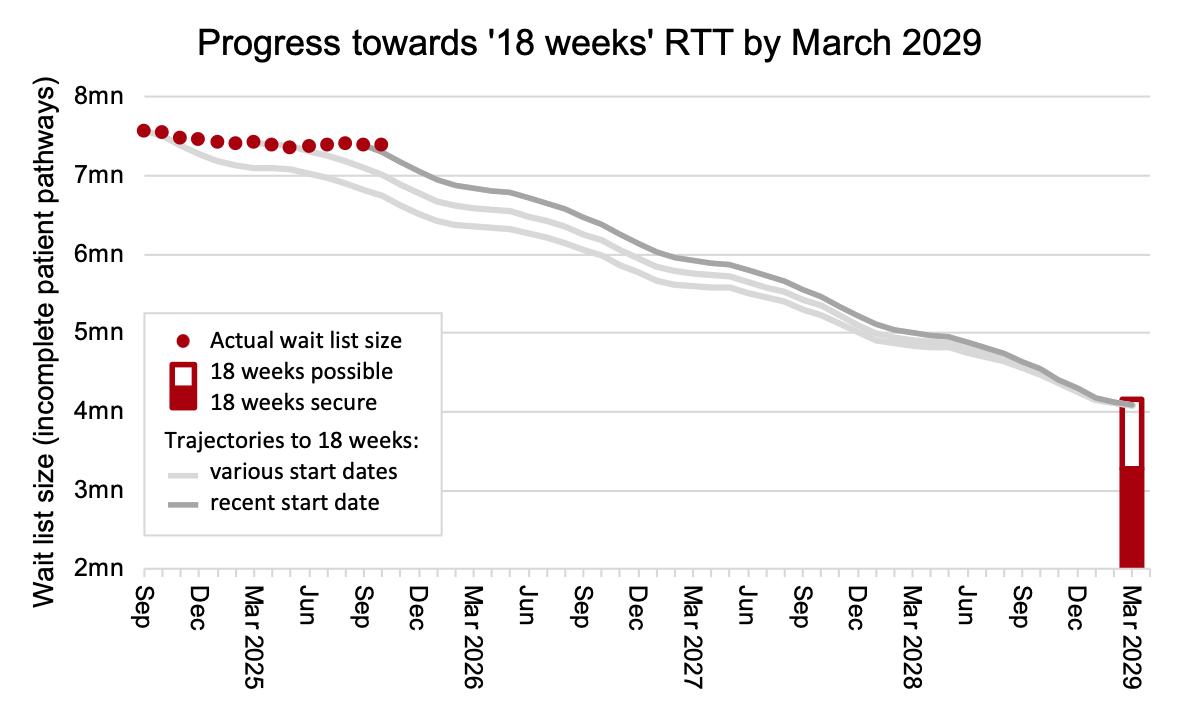
The waiting list has been shrinking year on year, which is a good thing. But it needs to shrink a lot faster to undo the rapid growth of the pandemic and restore the statutory 18 week waiting time standard.
Waiting times improved in October, as they often do around this time of year. RTT waiting times are now at their shortest since the shutdowns of the early pandemic.
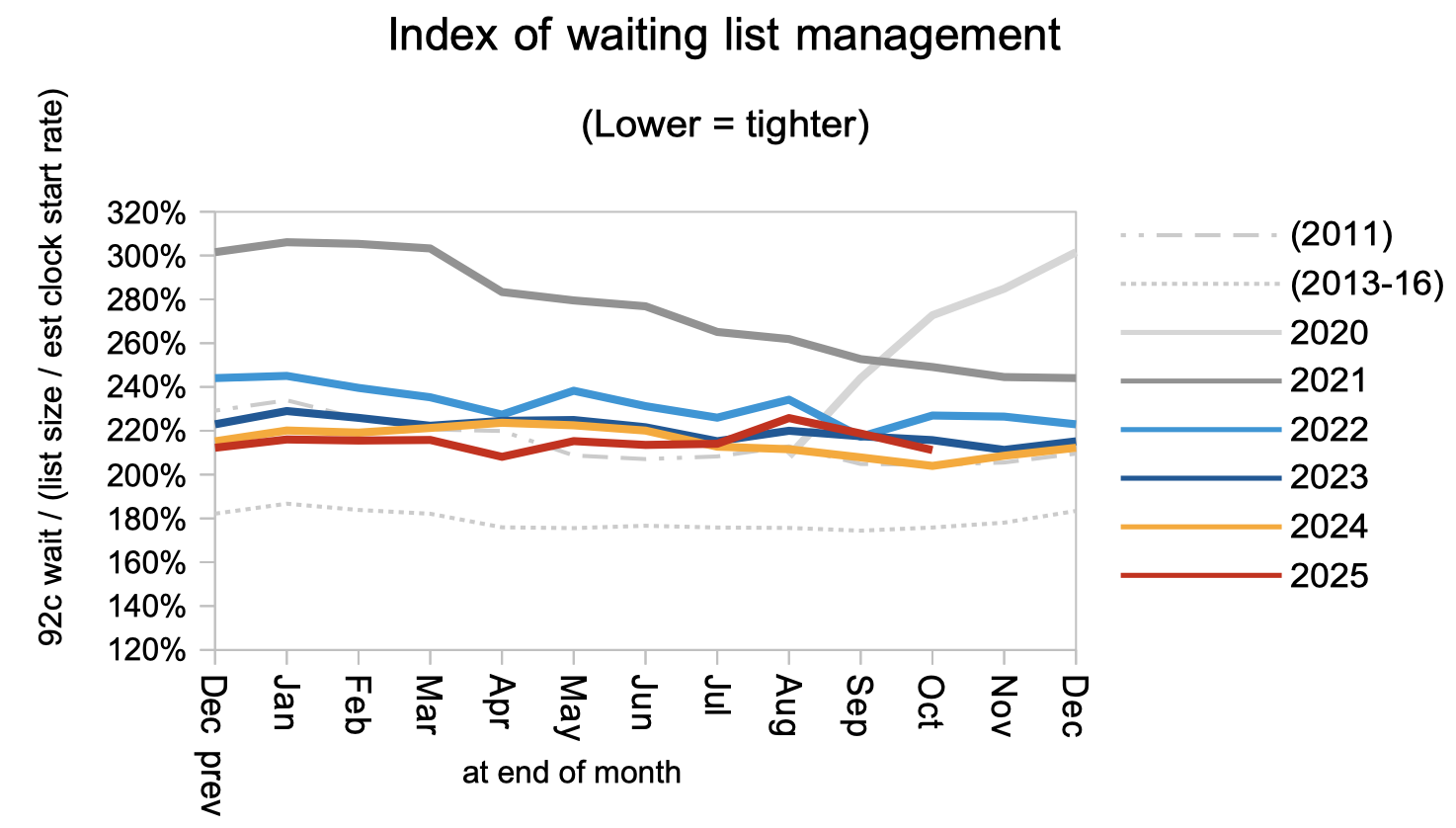
Waiting times are a function of both the size and shape of the waiting list, and the progress chart above assumes that both will improve towards 2029. We have already seen that the size of the list has not been improving fast enough, and the next chart shows that the shape has actually deteriorated year on year.
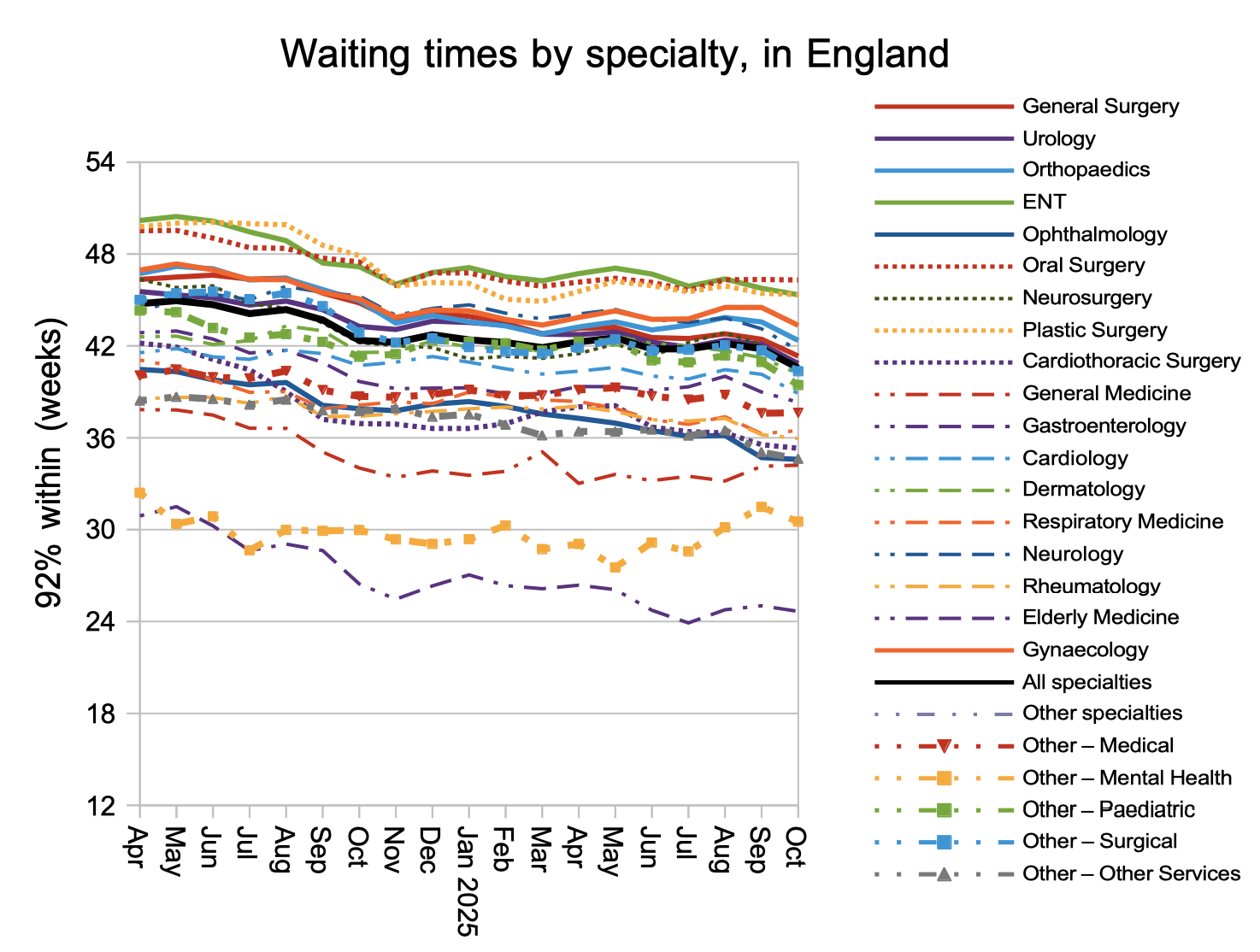
Before the pandemic, waiting times at specialty level fell into two mostly distinct groups: surgical specialties had longer waiting times, and medical specialties had shorter. Today the groups overlap, and this is not a good thing because medical specialties tend to have high rates of clinical priority.
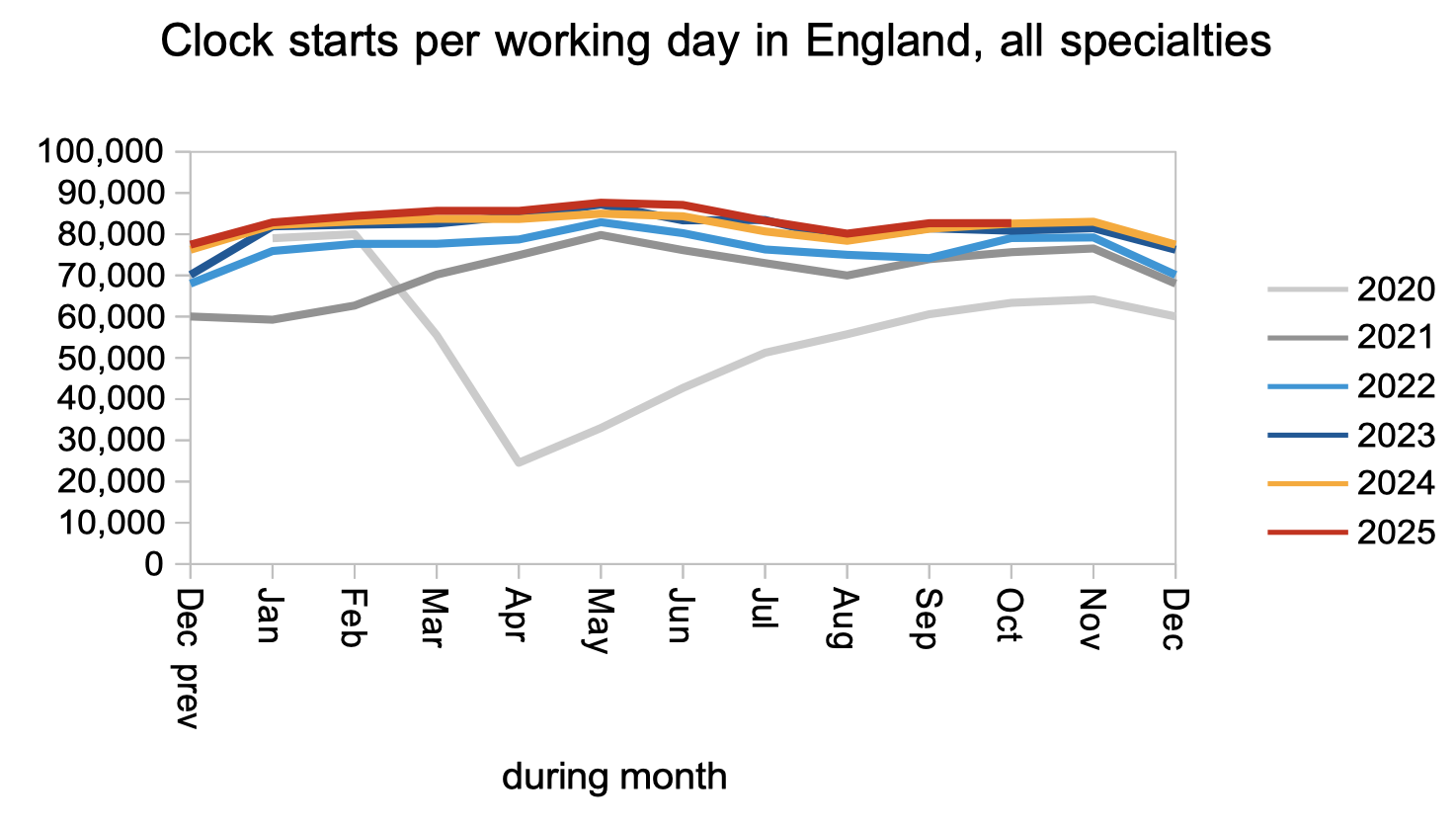
Waiting lists build up when patients are added to the waiting list faster than they are removed from it. Patients were added to the list (and started new waiting time ‘clocks’) at a similar rate to last year.
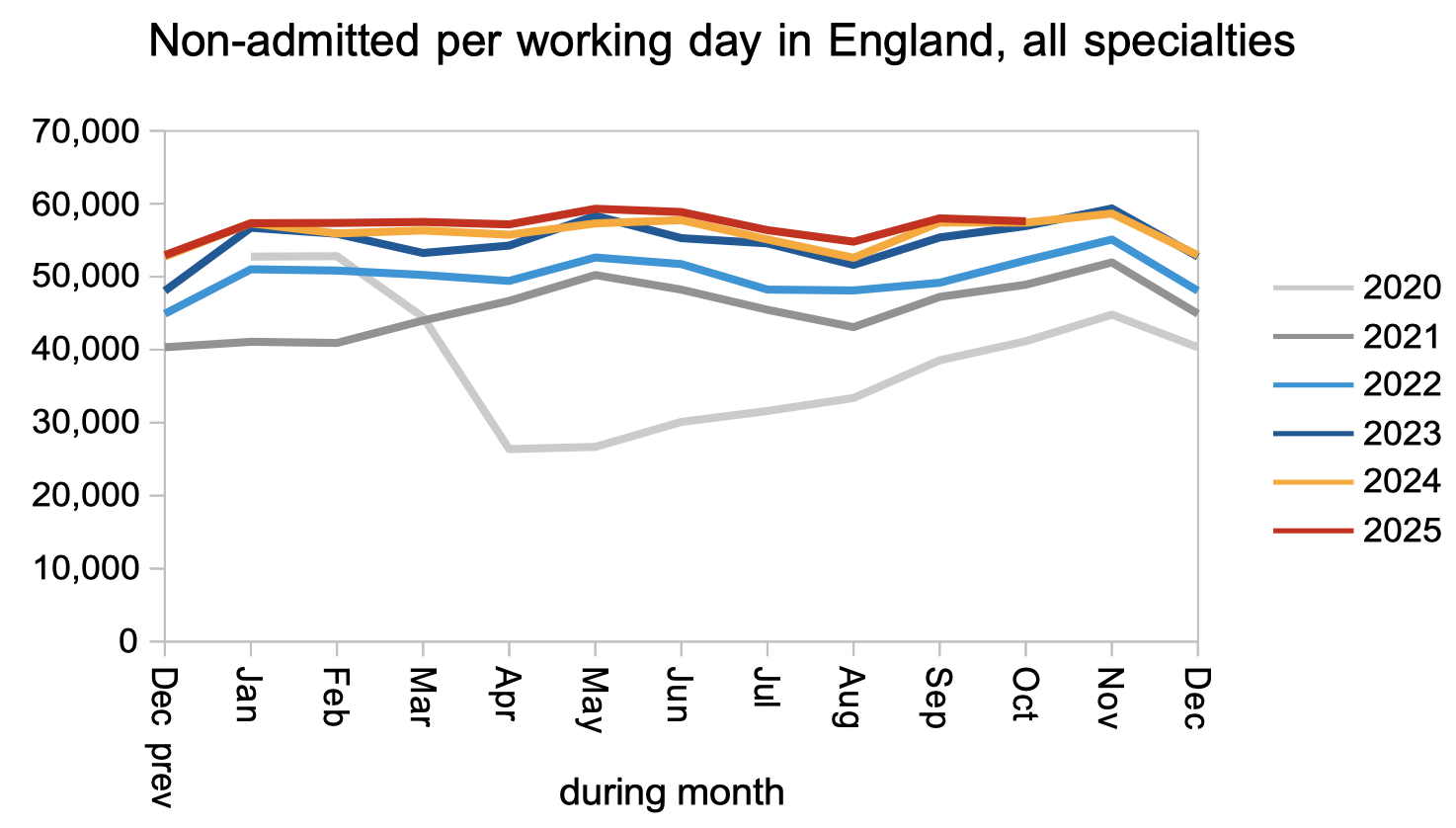
Patients were also discharged from outpatients and diagnostics at a similar rate to last year. Because most patients turn out not to require admission for inpatient and daycase treatment, increasing outpatient and diagnostic activity is an effective way to reduce waiting lists, waiting times, and the clinical risks of keeping undiagnosed patients waiting, all at low cost per case.
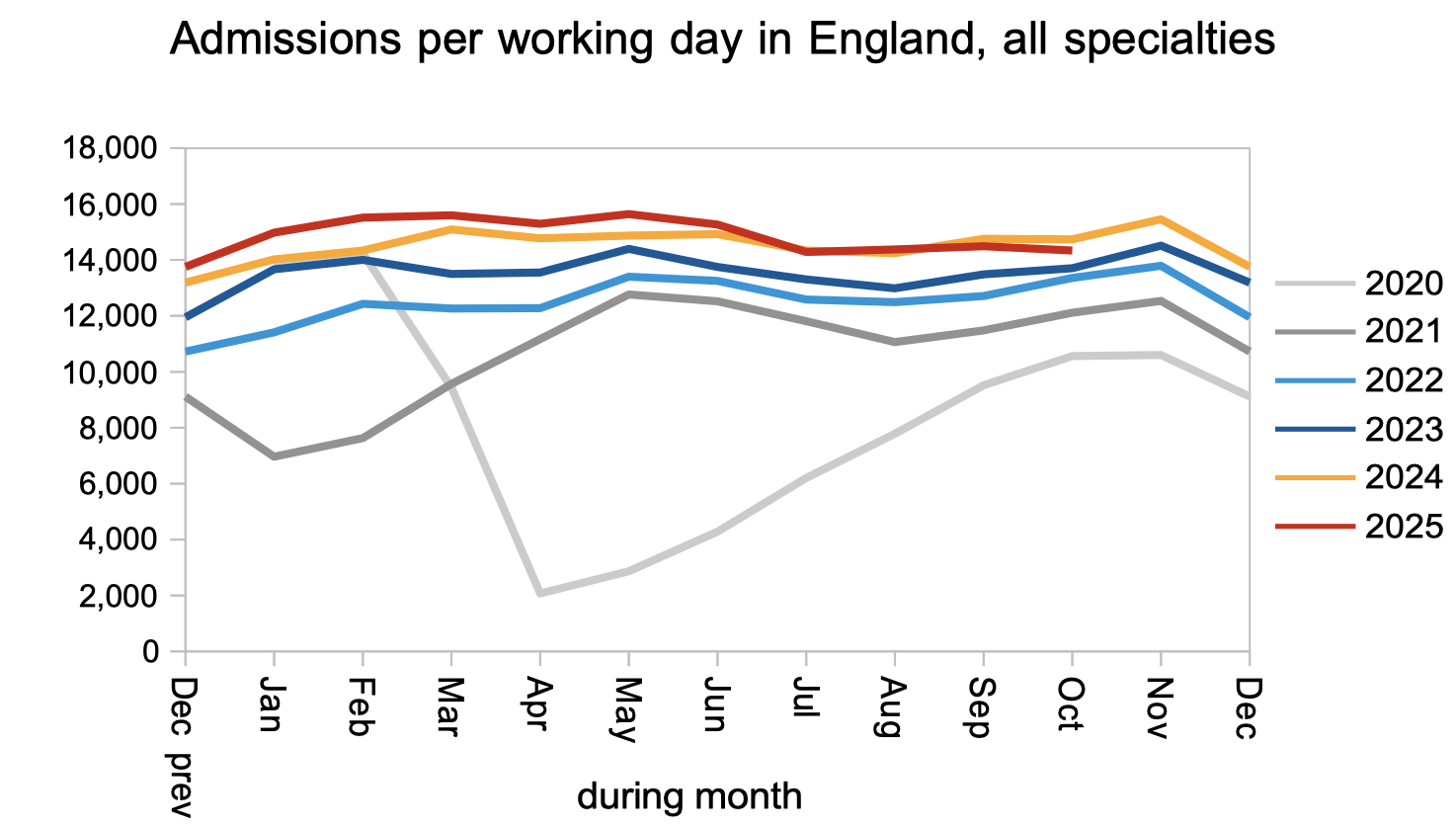
Recent months have seen a year on year slowdown in admissions for inpatient and daycase treatment, breaking the previous trend of steady improvement. This matters when it comes to reducing the longest waiting times: of those waiting less than a year, only 15 per cent are waiting for admission, compared with 37 per cent of those waiting longer.
Referral-to-treatment data up to the end of November is due out at 9:30am on Thursday 15th January 2026, a week later than usual because of the holidays.
Return to Post Index
Leave a Reply
You must be logged in to post a comment.